Why You Get Stuck in Sudoku (And How Expert Players Recover)
作者:OnlineSudoku 3 days ago 67 次阅读
Getting stuck is a normal part of solving Sudoku. Learn the most common reasons players hit a dead end and the techniques experienced solvers use to regain momentum without guessing.
Why You Get Stuck in Sudoku (And How Expert Players Recover)
Every Sudoku player knows the feeling.
The puzzle starts smoothly. Numbers fall into place. Rows and boxes begin filling up.
Then everything stops.
You scan the grid again.
Nothing.
You check every row, every column, every box.
Still nothing.
At this point many players assume they need a harder technique. Some start guessing.
In reality, neither is usually true.
Getting stuck is not a sign that the puzzle is impossible. More often, it is a sign that your attention is focused in the wrong place.
Understanding why players get stuck is one of the most valuable Sudoku skills you can develop.
Being Stuck Is Part of the Solving Process
One misconception among newer players is that strong solvers move through a puzzle continuously.
They don't.
Experienced players get stuck all the time.
The difference is that they recognize the situation quickly and know how to respond.
Sudoku is not a race to find the next number.
It is a process of gathering information.
Sometimes the next useful observation is obvious.
Sometimes it takes several minutes to find.
Both situations are completely normal.
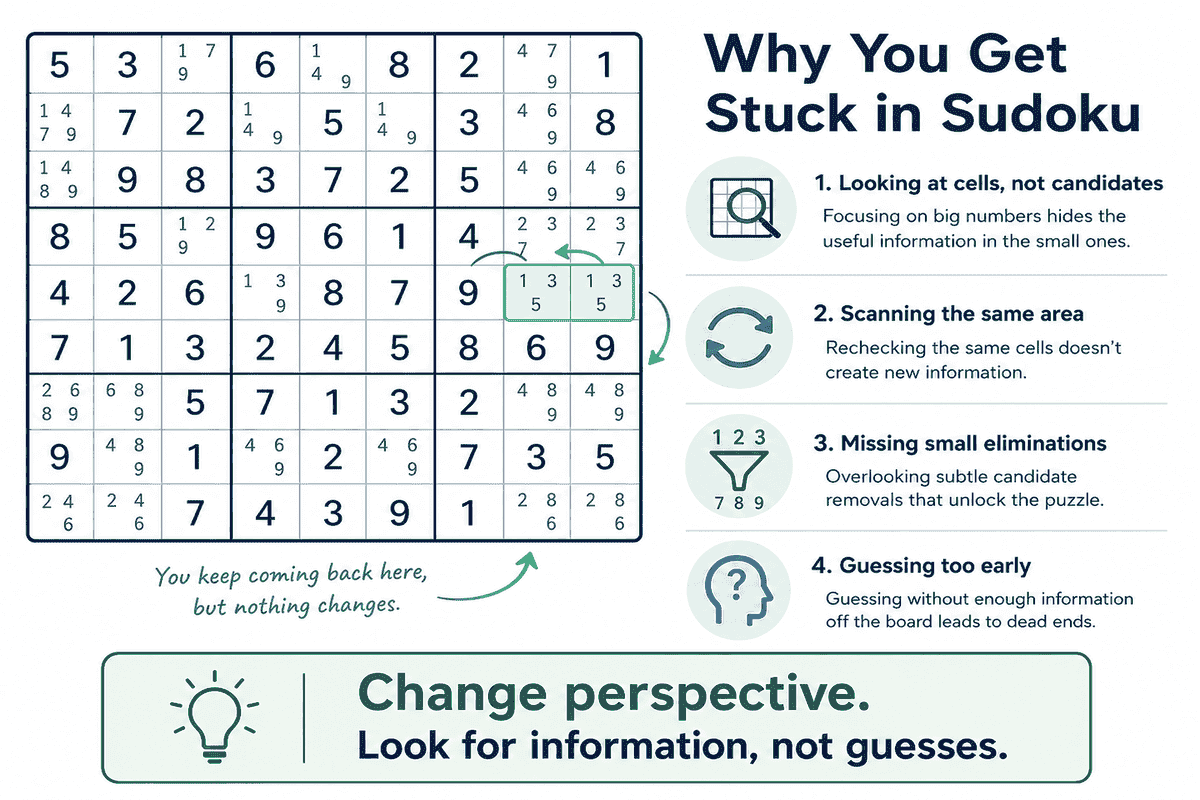
The Most Common Cause: Looking at Cells Instead of Candidates
When players reach a dead end, they often continue scanning the same empty cells repeatedly.
This rarely helps.
Strong solvers spend much less time asking:
What number goes here?
Instead they ask:
Where can this number go?
This is a subtle but important shift.
Sudoku becomes dramatically easier when viewed as a candidate-placement problem rather than a cell-filling problem.
If progress has stopped, try choosing a single number and tracking it across the entire grid.
You will often discover patterns that are invisible when looking cell-by-cell.
The Human Brain Loves Familiar Areas
Another reason players get stuck is surprisingly simple:
they keep looking at the same section of the puzzle.
Many people naturally focus on the area where they recently made progress.
As a result, they repeatedly scan the same rows and boxes while ignoring the rest of the grid.
Experienced solvers deliberately break this habit.
When progress stalls, they often switch perspectives entirely.
Instead of scanning rows, they scan columns.
Instead of examining one box, they examine all occurrences of a specific candidate.
A fresh viewpoint frequently reveals information that was already visible.
Missing Eliminations Creates Hidden Bottlenecks
Sometimes the puzzle is not difficult at all.
The real problem is that a small elimination was overlooked several moves earlier.
One missed candidate can block an entire chain of deductions.
This is why advanced players constantly update pencil marks and verify assumptions.
A puzzle that appears impossible may only require a single candidate removal to become solvable again.
Whenever you feel stuck, it is worth revisiting recently completed areas and checking for missed eliminations.
Harder Puzzles Require Pattern Recognition
Many intermediate players believe advanced Sudoku is about more complicated logic.
To a degree, this is true.
However, the bigger difference is pattern recognition.
Techniques such as:
- Locked Candidates
- X-Wing
- Swordfish
- XY-Wing
are not difficult because the logic is complicated.
They are difficult because the patterns are harder to see.
Strong solvers spend years developing the ability to recognize these structures quickly.
The logic itself is often straightforward once the pattern is identified.
Avoid the Guessing Trap
When progress disappears, guessing becomes tempting.
Sometimes a guess appears to work.
That creates a dangerous habit.
The problem is that guessing teaches very little.
Every time you bypass the logic of a puzzle, you lose an opportunity to improve your solving ability.
Most properly designed Sudoku puzzles can be solved logically from start to finish.
If you find yourself wanting to guess, treat that feeling as a signal.
There is probably information somewhere in the grid that you have not noticed yet.
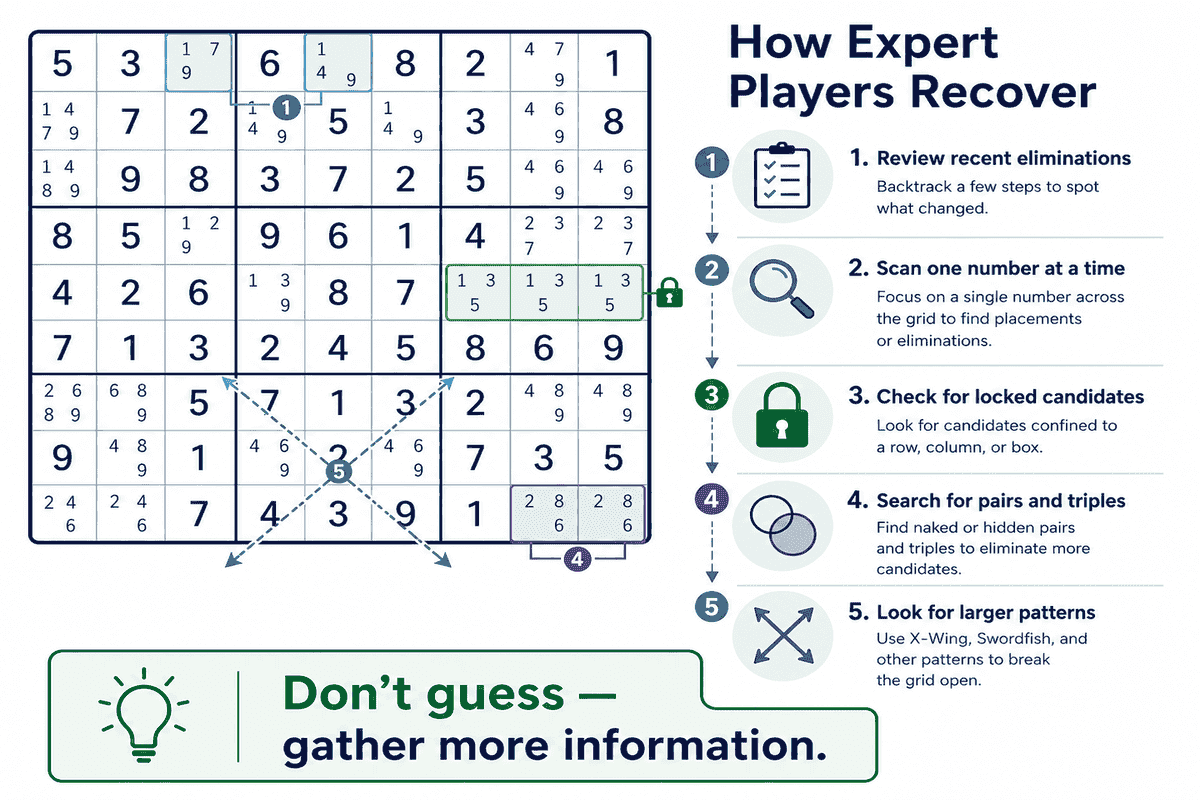
How Expert Solvers Recover
When experienced players get stuck, they rarely panic.
Instead, they follow a systematic process.
A common approach looks like this:
- Review recent eliminations.
- Scan candidates number by number.
- Check boxes for locked candidate opportunities.
- Search for pairs and triples.
- Look for larger structural patterns such as X-Wings.
Notice that none of these steps involve guessing.
The goal is simply to gather more information until a new deduction becomes available.
Training Yourself to Get Stuck Less Often
The best way to improve is not necessarily solving harder puzzles.
It is learning to recognize more patterns.
A useful training method is to focus on one technique at a time.
Spend a week looking specifically for:
- Hidden Pairs
- Locked Candidates
- X-Wings
Eventually those structures become familiar.
What once required several minutes becomes almost automatic.
This is how strong Sudoku players develop speed without sacrificing accuracy.
Final Thoughts
Getting stuck is not a failure.
In many ways, it is the most interesting part of Sudoku.
Easy moves test your attention.
Difficult positions test your understanding.
The players who improve fastest are not the ones who never get stuck.
They are the ones who learn how to respond when they do.
The next time a puzzle seems impossible, resist the urge to guess.
Slow down, change your perspective, and look for information instead of answers.
More often than not, the puzzle is waiting for you to notice something you have already seen.