How to Learn Sudoku Step by Step
By OnlineSudoku · 3 months ago · 204 views
A practical beginner-friendly guide to learning Sudoku properly, from understanding the grid to using candidates, spotting singles, avoiding guesses, and building a steady solving routine.
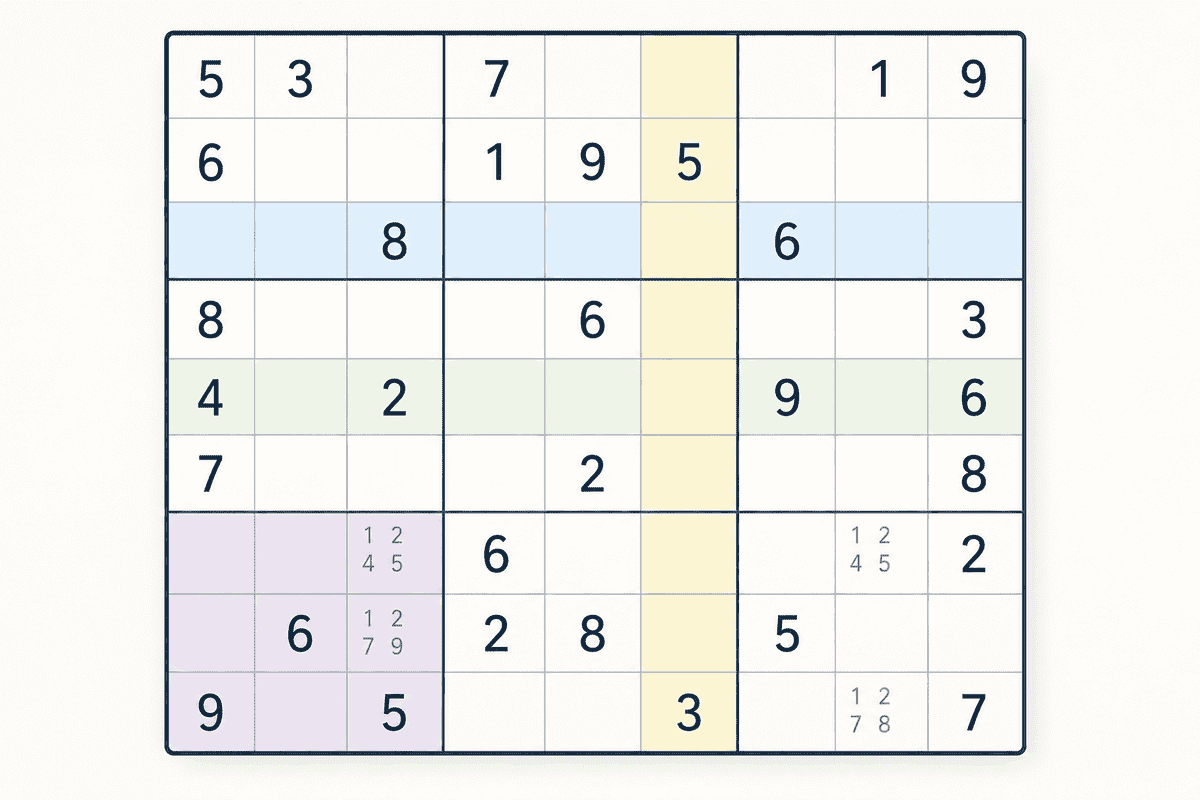
Sudoku is easy to start and surprisingly deep once you take it seriously. The rules fit into one sentence: fill the grid so every row, column, and 3x3 box contains the numbers 1 to 9 exactly once. The hard part is not remembering the rule. The hard part is learning how to look at the grid.
Most beginners struggle because they treat Sudoku like a guessing game. They stare at an empty cell, try a number that “feels right,” and then get stuck several moves later. Good Sudoku solving works differently. You learn to read the structure of the puzzle, narrow down possibilities, and place numbers only when the logic is strong enough.
This guide walks through Sudoku step by step, from the basic layout to practical solving habits. You do not need advanced techniques at the beginning. In fact, the best way to improve is to master the simple patterns first.
Step 1: Understand the Three Rules of the Grid
A standard Sudoku puzzle has 81 cells arranged in a 9x9 grid. The grid is divided into:
- 9 rows
- 9 columns
- 9 smaller 3x3 boxes
Every row must contain the numbers 1 through 9. Every column must also contain the numbers 1 through 9. Every 3x3 box follows the same rule.
That means a number cannot repeat in any row, column, or box.
If a row already has a 7, no other cell in that row can be 7. If a column already has a 4, no other cell in that column can be 4. If a 3x3 box already contains a 9, the remaining empty cells in that box cannot be 9.
This sounds basic, but it is the foundation of every Sudoku technique. Even advanced methods are just more careful ways of applying this same rule.
A useful habit is to stop thinking of a cell in isolation. Every empty cell belongs to three areas at the same time: one row, one column, and one box. A number is allowed in that cell only if it does not break any of those three areas.
Step 2: Start with Easy Puzzles, Not Random Puzzles
If you are learning Sudoku, start with easy puzzles. This is not about ego. Easy puzzles teach your eyes what real progress looks like.
A good beginner puzzle should give you enough clues that many numbers can be placed by direct logic. You should be able to solve parts of the grid without writing many candidates or making long chains of reasoning.
Hard puzzles are not better practice at the beginning. They often require techniques that you have not learned yet, and they can encourage bad habits, especially guessing.
Start with easy Sudoku until you can solve them steadily. Then move to medium puzzles. Only later should you spend serious time on hard or expert grids.
The goal is not to finish one difficult puzzle by luck. The goal is to build a solving process you can repeat.
Try this rhythm:
- Begin with easy puzzles until you rarely get stuck.
- Move to medium puzzles when you can finish easy ones calmly.
- Use hard puzzles only when you are comfortable with pencil marks and basic candidate logic.
That progression teaches you much more than jumping straight into difficult grids.
Step 3: Learn to Scan the Board
Scanning is the first real Sudoku skill. It means looking across rows, columns, and boxes to see where a number can or cannot go.
Pick a number, such as 1. Look at every 3x3 box and ask: where could a 1 fit here?
If a row already contains 1, then no empty cell in that row can be 1. If a column already contains 1, the same rule applies. By crossing out impossible positions, you may find that only one cell in a box can hold that number.
Then do the same for 2, 3, 4, and so on.
Beginners often scan too randomly. They look at one cell, then another, then jump across the grid without a plan. A better method is to scan one number at a time. This keeps your attention focused and reduces mistakes.
For example:
Look at all the 5s already placed in the puzzle. See which rows, columns, and boxes they control. Then check each box that does not yet contain a 5. Sometimes only one empty cell remains possible. That cell must be 5.
This technique is often called crosshatching. It is simple, but it solves a large portion of beginner and intermediate puzzles.
Step 4: Look for Obvious Singles
A single is a cell or a house where only one option remains.
There are two common kinds beginners should learn early.
The first is a naked single. This happens when one empty cell has only one possible number left. Suppose a cell sees 1, 2, 3, 4, 5, 6, 8, and 9 through its row, column, and box. The only number missing is 7, so that cell must be 7.
The second is a hidden single. This happens when a number has only one possible position inside a row, column, or box, even if that cell has several candidates written in it.
For example, a 3x3 box may have five empty cells. After checking the surrounding rows and columns, you may discover that only one of those cells can contain a 6. That cell must be 6, even if it also appears to allow other numbers at first glance.
Naked singles are about one cell. Hidden singles are about one number inside a row, column, or box.
Both are essential. Many players improve quickly once they stop looking only for naked singles and start asking, “Where can this number go?”
Step 5: Use Pencil Marks When the Puzzle Stops Being Obvious
At some point, scanning alone will slow down. That is when candidates become useful.
Candidates are small notes showing which numbers are still possible in an empty cell. If a cell could be 2, 5, or 8, you write those as candidates.
Good candidate notation helps you see patterns. Poor notation creates noise.
Do not fill every empty cell with every possible number too early. For beginners, that can make the grid harder to read. Start by adding candidates only in areas where you are working. As you get better, full candidate notation becomes more useful.
When writing candidates, always check the row, column, and box. A candidate is not a guess. It is a number that has survived elimination.
After placing a confirmed number, update related candidates in the same row, column, and box. If you place a 4, remove 4 from every candidate list affected by that placement.
This update step is where many mistakes happen. Beginners often place a correct number but forget to clean up candidates. Later, they make decisions based on old notes. That can ruin an otherwise good solve.
Step 6: Work One Area at a Time
Sudoku becomes easier when you stop trying to solve the whole board at once.
Choose a row, column, or box that already has many numbers filled in. Areas with six, seven, or eight completed cells are usually the best places to look. With fewer empty cells, there are fewer possibilities.
A row with seven numbers already placed has only two empty cells. If the missing numbers are 3 and 8, you only need to decide which empty cell gets which number. Check the columns and boxes connected to those cells. Often one of the numbers will be blocked from one position, leaving the answer clear.
The same idea works for boxes. A 3x3 box with only two or three empty cells is usually easier to finish than an open box with six empty cells.
This is one of the simplest ways to build momentum. Do not always start at the top-left corner. Start where the puzzle gives you the most information.
Step 7: Learn the Difference Between Solving and Guessing
A proper Sudoku puzzle has one solution. Every number can be placed by logic, although the logic may be simple or advanced depending on the difficulty.
Guessing means placing a number without enough proof. You might be right, but you have not solved anything. You have only made a bet.
There is a place for trial-and-error in some solving contexts, especially with very hard puzzles or computer solving. But if you are learning Sudoku, guessing too early slows your progress. It hides the technique you were supposed to discover.
A good rule is this: before placing a number, you should be able to explain why it must go there.
The explanation does not need to be fancy. “This cell is the only place for 8 in the box” is enough. “This cell can only be 2 because every other number is blocked” is enough.
“I think it is probably 5” is not enough.
If you cannot explain the placement, leave it as a candidate and continue searching.
Step 8: Build a Repeatable Solving Routine
A strong beginner routine might look like this:
- Scan number by number from 1 to 9.
- Look for easy placements in boxes, rows, and columns.
- Check nearly completed areas.
- Add candidates in the most active parts of the puzzle.
- Look for naked singles and hidden singles.
- After every placement, update candidates and rescan the affected area.
This routine may sound slow at first. But after a few puzzles, it becomes natural. You will start seeing common shapes faster. You will notice that placing one number often unlocks another number nearby.
Sudoku solving is not a straight line. It is a loop.
Scan, place, update, rescan.
That loop is the heart of the game.
Step 9: Avoid the Most Common Beginner Mistakes
The most common mistake is placing a number because it looks convenient. Sudoku does not reward convenience. It rewards proof.
Another common mistake is ignoring boxes. Many beginners focus on rows and columns but forget that every 3x3 box has equal power. Often the box is where the strongest clue appears.
A third mistake is failing to update notes. If your candidates are old, your logic is unreliable. Treat candidate cleanup as part of the move, not something optional.
Some beginners also switch techniques too quickly. They scan for a few seconds, see nothing, then assume they need an advanced method. Usually they just need to scan more carefully or choose a better area of the grid.
Finally, do not rush. Speed comes from clean habits. If you try to solve fast before you solve accurately, you will train yourself to make fast mistakes.
Step 10: Know When to Learn the Next Technique
Once you are comfortable with singles and scanning, you can begin learning beginner-to-intermediate techniques.
The next useful ideas are pairs and locked candidates.
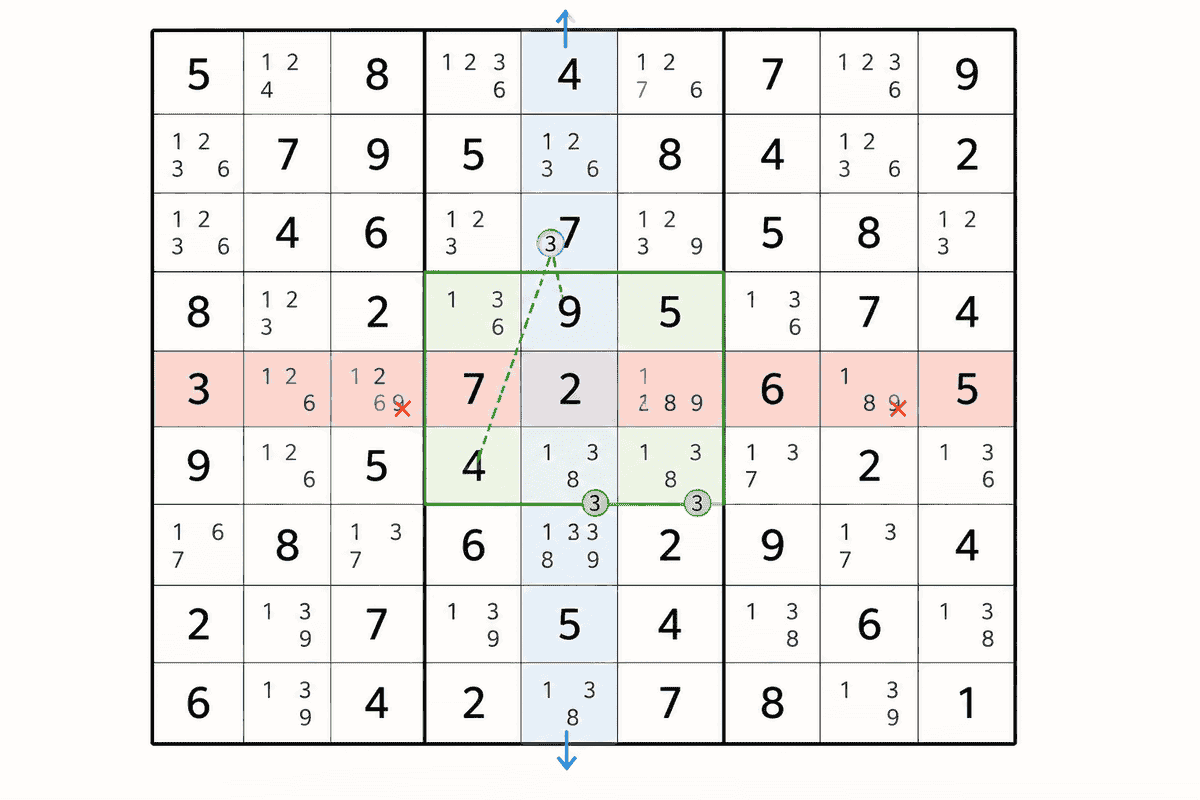
A naked pair appears when two cells in the same row, column, or box contain the same two candidates and no others. Those two numbers must occupy those two cells, so they can be removed from other cells in that area.
A hidden pair works in the opposite direction. Two numbers can only appear in the same two cells inside a row, column, or box, even if those cells contain extra candidates. Once you spot the pair, the extra candidates can be removed.
Locked candidates help when a number inside a 3x3 box is restricted to one row or one column. That restriction can eliminate the same number from the rest of that row or column outside the box.
You do not need to learn everything at once. Add one technique at a time. Practice it until it feels visible. Then move on.
For most players, a good learning order is:
- Singles
- Scanning
- Candidates
- Pairs
- Locked candidates
- X-Wing and other advanced patterns
A Simple Practice Plan for Beginners
If you want to learn Sudoku properly, practice in short sessions. One focused puzzle teaches more than five rushed puzzles.
For the first week, solve easy puzzles and write down where you get stuck. Do not worry about speed. Pay attention to how often you find singles, how often you miss box-based logic, and whether your candidate notes stay clean.
In the second week, start solving medium puzzles. Use candidates more often, but still avoid guessing. When you get stuck, review each row, column, and box systematically before looking for hints.
In the third week, study one technique such as naked pairs or locked candidates. Then solve puzzles where that technique appears. The goal is not just to read about the method. The goal is to recognize it in a real grid.
Sudoku skill grows through pattern memory. At first, every move feels separate. Later, familiar arrangements start to stand out. You see a nearly completed box and know where to check. You see two cells with the same candidates and pause. You see a number locked into one line and understand what it removes.
That is when Sudoku becomes much more enjoyable.
Final Thoughts
Learning Sudoku is not about memorizing dozens of tricks. It is about training your eyes to notice restrictions.
Every number already placed on the board tells you something. Every row, column, and box removes possibilities. Every confirmed move should make the puzzle a little smaller.
Start with easy puzzles. Scan carefully. Use candidates when needed. Place numbers only when you can explain them. Review your mistakes without frustration.
If you build those habits early, harder Sudoku puzzles will feel less mysterious. They will still be challenging, but the challenge will be logical rather than confusing.
Sudoku is at its best when every step makes sense. Learn that way from the beginning, and your solving will become faster, cleaner, and much more satisfying.