Sudoku Tips: Locked Candidates Explained (Pointing & Claiming)
By OnlineSudoku 5 months ago 645 views
Learn how Locked Candidates work in Sudoku, including the Pointing and Claiming techniques. These essential intermediate strategies help eliminate candidates and create progress in tougher puzzles.
Most Sudoku players eventually run into the same problem.
The easy singles disappear, obvious eliminations stop working, and the puzzle suddenly feels much harder than it did a few minutes earlier.
At that stage, solving becomes less about individual cells and more about understanding how different parts of the grid interact.
One of the most useful techniques for this transition is Locked Candidates.
This strategy appears frequently in intermediate and expert puzzles because it creates eliminations by connecting rows, columns, and boxes together.
What Are Locked Candidates?
Locked Candidates occur when the possible positions for a number become restricted within a row, column, or 3×3 box.
Once that restriction exists, certain candidates elsewhere in the grid can no longer be valid.
There are two forms of the technique:
- Pointing
- Claiming
Although they are usually taught separately, both rely on the same core principle:
If a candidate is forced into a specific area, it can often be removed from somewhere else.
Pointing
How Pointing Works
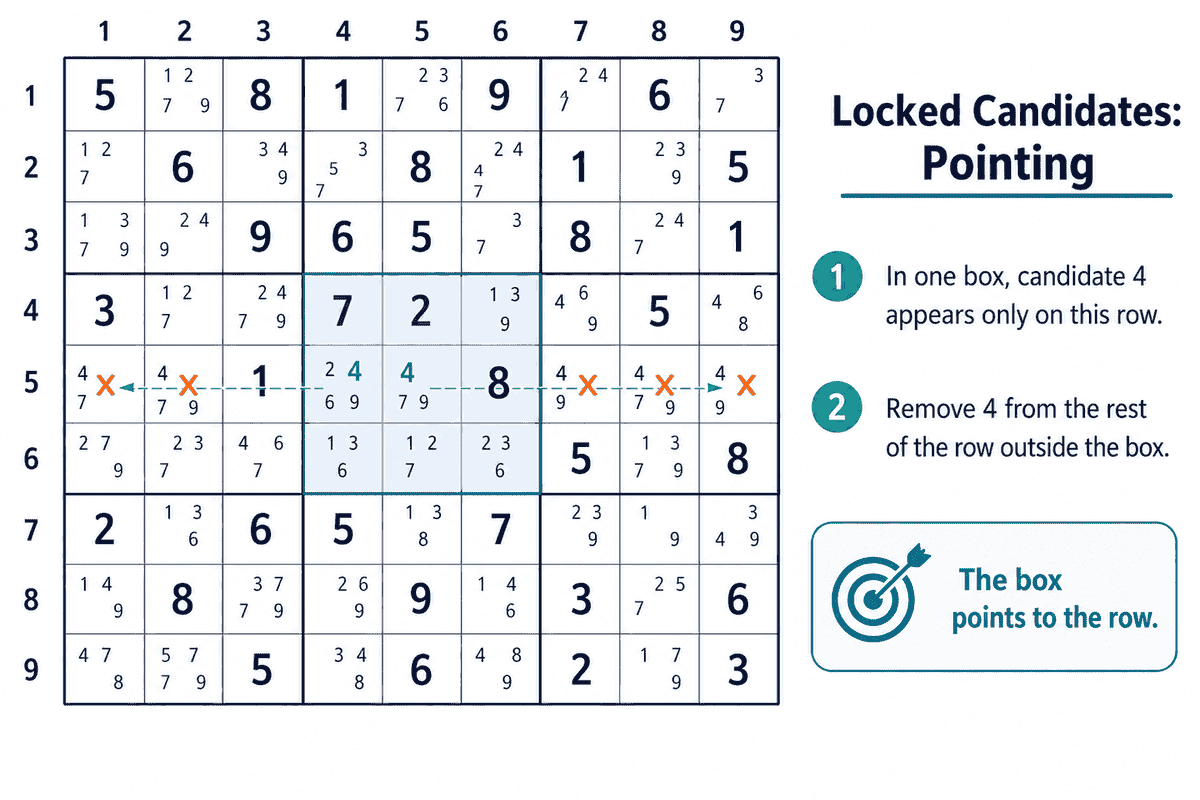
Pointing occurs inside a 3×3 box.
If all possible positions for a candidate within that box lie in the same row or column, the candidate becomes “locked” into that line.
Because of that, the same candidate can be eliminated from the rest of the row or column outside the box.
Pointing Example
Suppose candidate 4 appears only twice inside a box.
Both candidate 4s are located in the same row.
That means the final placement for 4 in that box must occur somewhere along that row.
As a result:
- Any other candidate 4s elsewhere in the same row
- Outside the box
- Can be removed
The box effectively “points” into the row.
Why Pointing Matters
Pointing is important because it creates eliminations that are easy to miss during normal scanning.
Many puzzles become solvable again after just one clean pointing elimination.
It is also one of the first techniques that teaches players to think beyond isolated cells.
Claiming
How Claiming Works
Claiming works in the opposite direction.
Instead of starting from a box, it begins with a row or column.
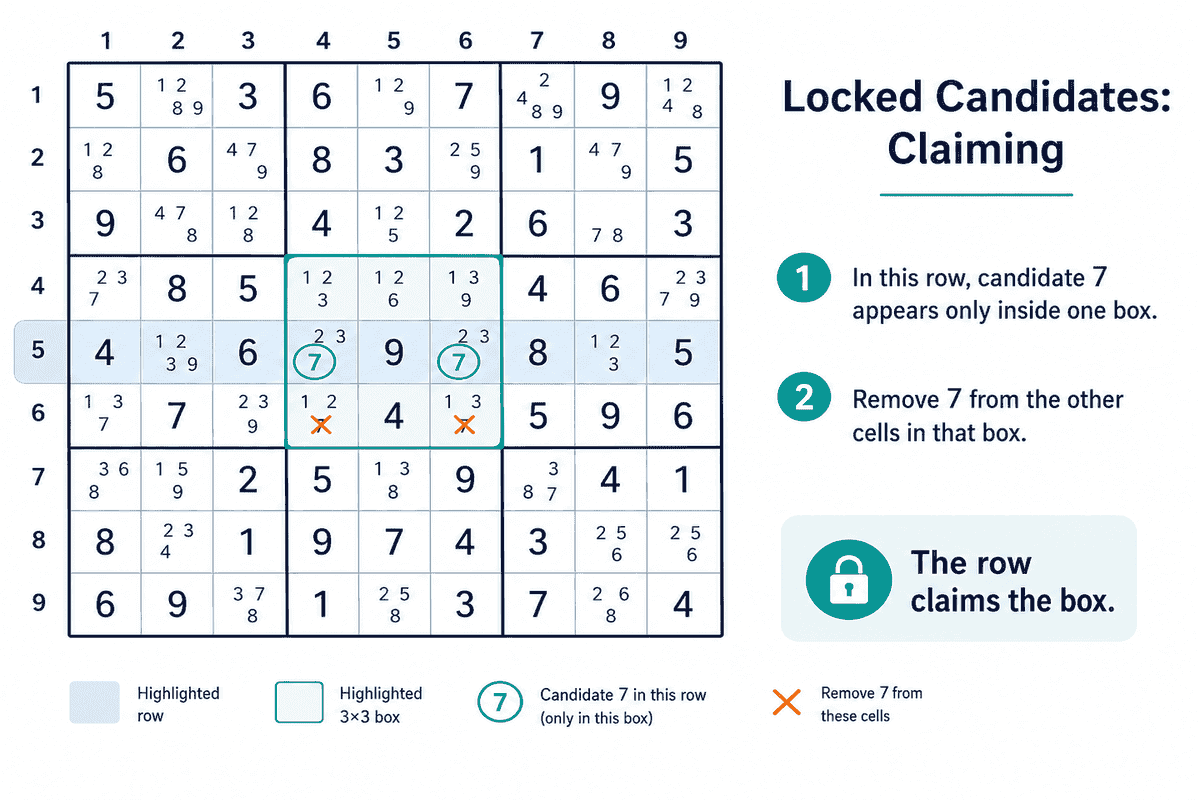
If all possible positions for a candidate in a row are confined to a single box, then that candidate must ultimately be placed somewhere inside that box.
Therefore:
- The same candidate can be removed from other cells within the box
Claiming Example
Imagine candidate 7 appears only twice in a row.
Both candidates happen to fall inside the same 3×3 box.
Since the row must place its 7 somewhere inside that box, any other candidate 7s within the box become impossible.
Those candidates can be eliminated safely.
In this case, the row is effectively “claiming” part of the box.
Pointing vs Claiming
These two patterns are closely related, but the direction of elimination is different.
| Technique | Starting Area | Elimination Area |
|---|---|---|
| Pointing | Box | Row or column |
| Claiming | Row or column | Box |
A useful way to remember them:
- Pointing pushes outward from a box
- Claiming pulls inward into a box
How to Spot Locked Candidates
The most effective approach is to scan candidate-by-candidate rather than cell-by-cell.
Choose a number and follow its positions carefully across the grid.
Look for situations where:
- A box restricts a candidate to one line
- A line restricts a candidate to one box
These patterns become much easier to recognize once pencil marks are organized clearly.
Experienced solvers often identify Locked Candidates almost automatically while scanning.
Common Mistakes
Removing Candidates Too Early
The restriction must be complete.
If a candidate still appears elsewhere in the box, row, or column, the pattern is invalid.
Confusing Pointing and Claiming
The underlying logic is similar, but the elimination direction changes.
Understanding where the restriction begins is more important than memorizing the names.
Ignoring Partial Information
Locked Candidates often appear before the board looks “advanced.”
Many players miss them simply because they stop scanning too soon.
When Should You Use Locked Candidates?
Locked Candidates usually become useful once basic singles and pairs begin slowing down.
They appear frequently in:
- Medium difficulty puzzles
- Hard classic Sudoku
- Candidate-heavy late-game situations
In many cases, a single Locked Candidate elimination is enough to restart progress across the grid.
Developing Better Pattern Recognition
Like most intermediate Sudoku techniques, Locked Candidates are less about calculation and more about recognition.
Strong players are constantly watching how candidates cluster together.
Over time, these interactions become easier to notice naturally.
The important thing is not speed.
It is learning to read the structure of the puzzle accurately.
Final Thoughts
Locked Candidates are one of the most practical techniques in Sudoku because they appear often and produce reliable eliminations without requiring advanced chain logic.
For many players, this is the point where Sudoku starts becoming more strategic and far less dependent on trial-and-error.
Once you become comfortable with Pointing and Claiming, the entire grid begins to feel more connected — and difficult puzzles become much easier to control.