Sudoku Tips: Swordfish Guide for Advanced Candidate Elimination
By OnlineSudoku 3 months ago 288 views
Learn how the Swordfish technique works in Sudoku, how it extends the logic of X-Wing, and how to use it for advanced candidate elimination without guessing.
Swordfish is one of the better-known advanced Sudoku techniques. It belongs to the same family as X-Wing, but it is larger and harder to spot.
Where X-Wing uses two rows and two columns, Swordfish uses three rows and three columns.
The idea is not complicated once the structure is clear. Swordfish does not usually place a number directly. Like many advanced techniques, its purpose is to remove candidates. Sometimes that removal is enough to reveal a single. Other times it simply makes the grid cleaner and allows another technique to work.
The key is understanding that Swordfish is not a guess, and it is not a pattern you force onto the grid. It is a precise candidate restriction.
What Is a Swordfish?
A Swordfish occurs when one candidate is restricted across three rows and three columns.
In a row-based Swordfish:
- Choose one candidate.
- Find three rows where that candidate appears only in the same three columns.
- Those three rows must place the candidate somewhere within those three columns.
- Therefore, the same candidate can be removed from other cells in those columns.
The same idea also works in reverse with columns and rows.
In short:
| Pattern | Base Units | Cover Units | Eliminate From |
|---|---|---|---|
| Row-based Swordfish | 3 rows | 3 columns | Other cells in those columns |
| Column-based Swordfish | 3 columns | 3 rows | Other cells in those rows |
Swordfish is best understood as a larger X-Wing. An X-Wing uses two base units and two cover units. A Swordfish uses three.
A Simple Row-Based Example
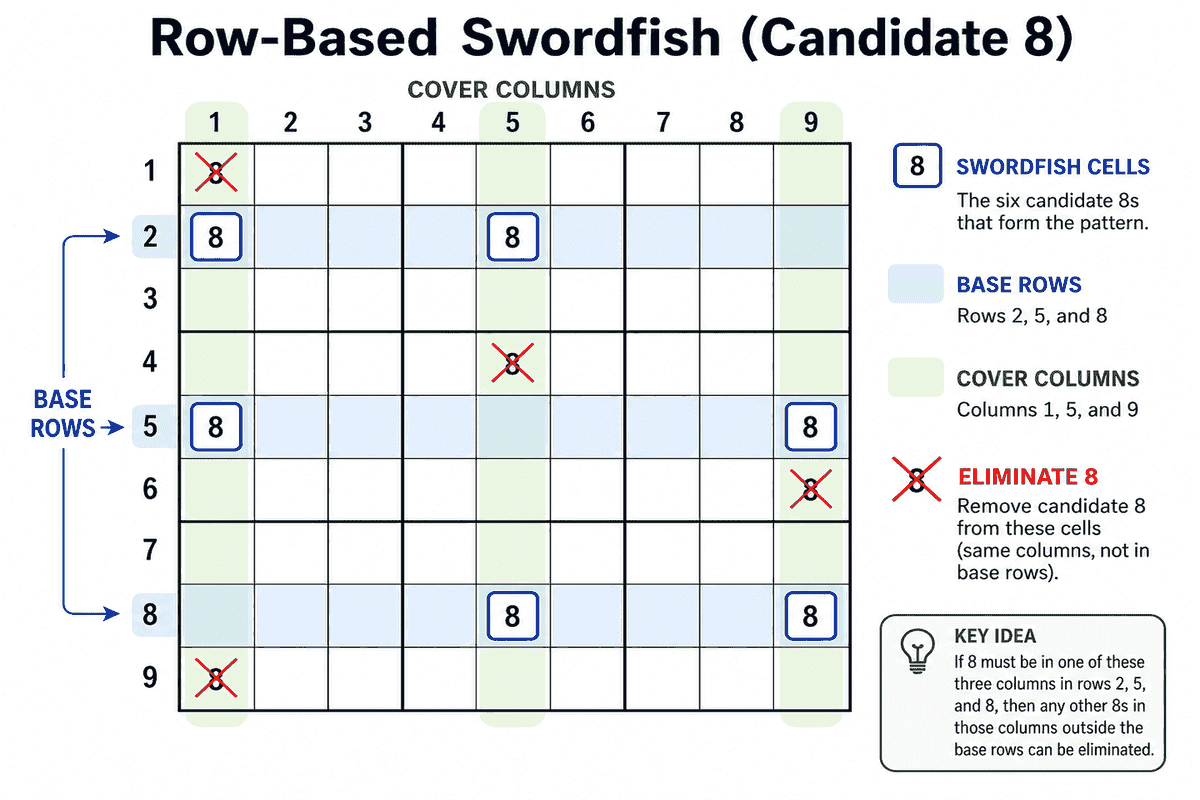
Suppose you are checking candidate 8.
You notice the following candidate positions:
| Row | Possible positions for 8 |
|---|---|
| Row 2 | Column 1, Column 5 |
| Row 5 | Column 1, Column 9 |
| Row 8 | Column 5, Column 9 |
Look carefully at the columns involved.
Across these three rows, candidate 8 appears only in:
- Column 1
- Column 5
- Column 9
That creates a Swordfish.
The candidate 8 in Rows 2, 5, and 8 must occupy Columns 1, 5, and 9 in some arrangement. Because those three rows will use the 8s in those three columns, any other candidate 8s in Columns 1, 5, or 9 can be removed.
For example:
- r1c1 cannot be 8
- r4c5 cannot be 8
- r6c9 cannot be 8
- r9c1 cannot be 8
Those cells are outside the three Swordfish rows, so they cannot contain 8.
Why Swordfish Works
The logic behind Swordfish is based on balance.
Three rows must each contain the candidate once. If, in those three rows, the candidate is limited to the same three columns, then those three columns are already reserved for the candidate.
No matter how the final arrangement works, each of the three selected rows will place the candidate in one of the three selected columns.
That means the candidate cannot appear elsewhere in those columns.
This is the important part:
Swordfish does not tell you exactly where the candidate goes. It tells you where the candidate cannot go.
That is why Swordfish is an elimination technique rather than a placement technique.
Column-Based Swordfish
Swordfish also works vertically.
A column-based Swordfish occurs when a candidate appears in three columns, and within those columns it is restricted to the same three rows.
For example:
| Column | Possible positions for 6 |
|---|---|
| Column 2 | Row 1, Row 7 |
| Column 4 | Row 1, Row 9 |
| Column 8 | Row 7, Row 9 |
Across Columns 2, 4, and 8, candidate 6 appears only in:
- Row 1
- Row 7
- Row 9
That forms a column-based Swordfish.
The eliminations now happen across the rows. Any other candidate 6s in Rows 1, 7, or 9 can be removed, as long as they are outside Columns 2, 4, and 8.
So the direction is reversed:
- Row-based Swordfish eliminates from columns.
- Column-based Swordfish eliminates from rows.
This is the same directional rule used in X-Wing, just expanded to three units.
Swordfish vs X-Wing
Swordfish is often introduced after X-Wing because the logic is almost identical.
The difference is size.
| Technique | Structure | Difficulty |
|---|---|---|
| X-Wing | 2 rows and 2 columns | Easier to spot |
| Swordfish | 3 rows and 3 columns | Harder to spot |
An X-Wing is usually clean and rectangular. A Swordfish is often less visually obvious.
The candidate positions do not always form a neat shape on the grid. Some rows may have two candidate positions, while others may have three.
That is why many players miss Swordfish even when the logic is available.
The pattern is not about making a pretty shape. It is about candidate restriction.
What Makes a Valid Swordfish?
A valid Swordfish needs a few specific conditions.
1. One Candidate Only
Swordfish always works on a single candidate.
You cannot combine different numbers into one Swordfish pattern. If you are checking 8, every part of the pattern must involve candidate 8.
2. Three Base Units
A row-based Swordfish uses three rows.
A column-based Swordfish uses three columns.
These are the units where the candidate is restricted.
3. Three Cover Units
The candidate positions in the base units must be limited to exactly three cover units.
For a row-based Swordfish, those cover units are columns.
For a column-based Swordfish, those cover units are rows.
If the candidate spreads into a fourth cover unit, the Swordfish is not valid.
4. Safe Eliminations Only
Candidates are removed from the cover units outside the base units.
For example, in a row-based Swordfish, you remove the candidate from the selected columns, but only in rows that are not part of the Swordfish.
You do not remove the candidate from the Swordfish cells themselves. Those cells are the reason the pattern exists.
How to Spot Swordfish
The most reliable way to find Swordfish is to scan one candidate at a time.
Do not look for Swordfish randomly across the whole grid. That usually leads to confusion.
A better method:
- Choose one candidate, such as 3.
- Scan each row.
- Mark rows where that candidate appears in two or three positions.
- Compare those rows.
- Look for three rows whose candidate positions are limited to the same three columns.
- If the pattern is valid, eliminate that candidate from the rest of those columns.
Then repeat the same process using columns as the base units.
At first, this may feel slow. That is normal. Swordfish is not meant to be found by casual scanning. It becomes easier only after you develop the habit of reading candidates systematically.
A More Realistic Swordfish Pattern
Many examples make Swordfish look too perfect.
In real puzzles, it often appears in a less symmetrical form.
For candidate 4, you might see this:
| Row | Possible positions for 4 |
|---|---|
| Row 1 | Column 2, Column 6, Column 8 |
| Row 4 | Column 2, Column 8 |
| Row 7 | Column 6, Column 8 |
The three rows involved are:
- Row 1
- Row 4
- Row 7
The only columns involved are:
- Column 2
- Column 6
- Column 8
This is still a Swordfish.
The rows do not need to have identical candidate positions. They only need to be restricted to the same three columns overall.
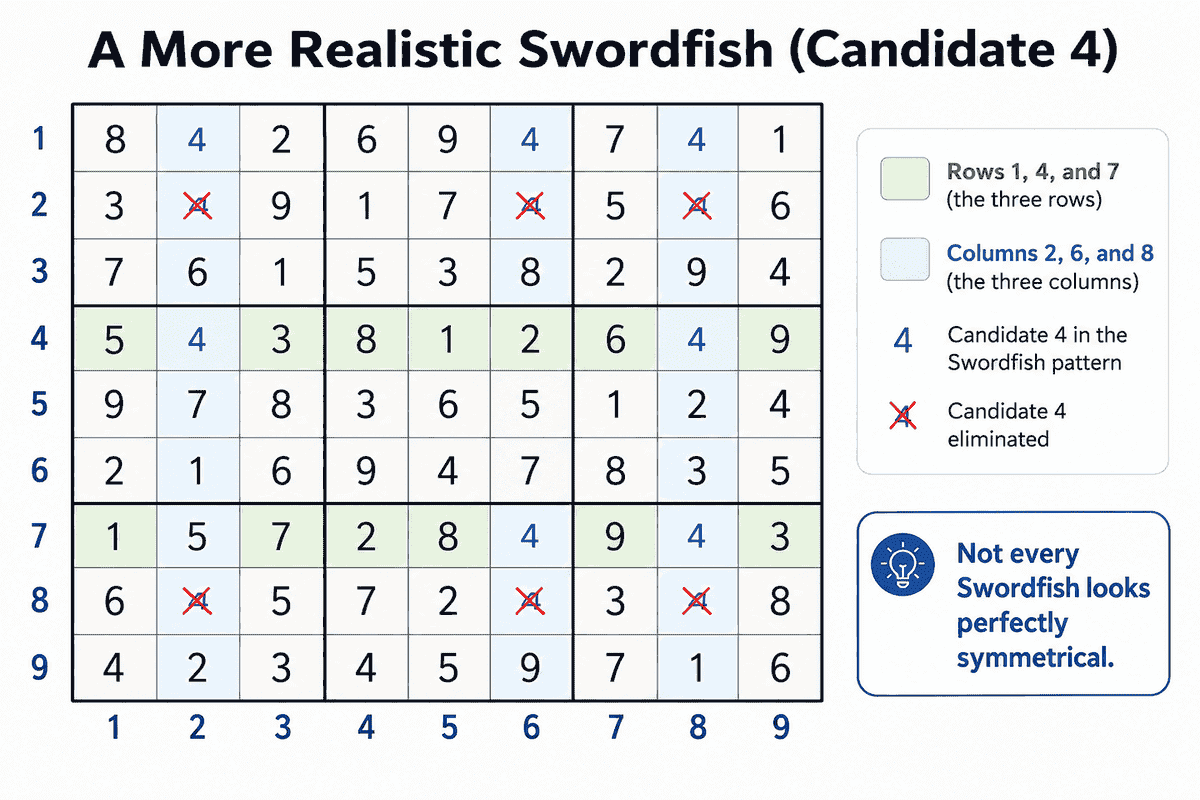
That detail matters. Many players look only for three rows with identical candidate layouts. That is too narrow and will miss many valid Swordfish patterns.
Common Mistakes
Mistake 1: Expecting a Perfect Shape
Swordfish does not always look like a clean rectangle or grid pattern.
Some rows may contain two candidate positions. Others may contain three. The visual shape can be uneven.
What matters is whether three rows are locked into the same three columns, or three columns are locked into the same three rows.
Mistake 2: Eliminating from the Wrong Direction
This is the most common technical error.
If the Swordfish starts from rows, eliminate from columns.
If it starts from columns, eliminate from rows.
The base units define the pattern. The cover units receive the eliminations.
Mistake 3: Including a Row or Column with Extra Candidates
A Swordfish fails if one of the base rows or columns has the candidate outside the three cover units.
For example, if you are building a row-based Swordfish and one of the three rows also has candidate 8 in a fourth column, the pattern is invalid.
The restriction is no longer tight enough.
Mistake 4: Removing Candidates from the Swordfish Cells
The Swordfish cells themselves must remain possible.
You only remove candidates from other cells in the cover units.
If the Swordfish uses Rows 2, 5, and 8 with Columns 1, 5, and 9, do not remove the candidate from the intersections of those rows and columns.
Those intersections are the possible placements.
When Should You Look for Swordfish?
Swordfish is usually not an early-game technique.
Before looking for it, check simpler strategies first:
- Naked Singles
- Hidden Singles
- Naked Pairs
- Hidden Pairs
- Locked Candidates
- X-Wing
If those techniques no longer produce progress, Swordfish becomes worth checking.
It is especially useful when one candidate appears in repeated two-position or three-position patterns across multiple rows or columns.
In many puzzles, Swordfish appears after the grid has already been cleaned up by simpler eliminations.
Why Swordfish Is Hard to See
Swordfish is difficult mainly because it requires comparing multiple units at once.
With X-Wing, you compare two rows or two columns. With Swordfish, you compare three.
That extra unit makes the pattern much less obvious. It also creates more false positives.
A group of candidates may look close to Swordfish but fail because one row contains an extra position, or because the columns do not line up cleanly.
This is why patient verification is important. Swordfish rewards careful scanning more than speed.
Practice Method
The best way to learn Swordfish is not to search every puzzle for it immediately.
Instead, practice it deliberately.
Try this approach:
- Pick one candidate.
- List the rows where that candidate appears two or three times.
- Write down the columns for those appearances.
- Compare groups of three rows.
- Check whether the total column set is exactly three columns.
- Look for eliminations outside the pattern.
This method may feel mechanical, but it teaches the structure clearly.
After enough practice, you will begin recognizing Swordfish patterns without writing everything out.
Swordfish and the Fish Family
Swordfish is part of a larger group of Sudoku techniques often called fish patterns.
The common forms are:
| Technique | Size |
|---|---|
| X-Wing | 2 by 2 |
| Swordfish | 3 by 3 |
| Jellyfish | 4 by 4 |
They all use the same basic logic.
If a candidate is restricted to a matching number of rows and columns, eliminations become possible outside the pattern.
Understanding Swordfish makes Jellyfish easier to learn later, even though Jellyfish is rarer and usually harder to spot.
Final Thoughts
Swordfish is a serious step up from X-Wing. The logic is still clean, but the pattern is larger and easier to overlook.
The most important thing is not memorizing the name. It is understanding the restriction:
three rows tied to three columns, or three columns tied to three rows.
Once that restriction is real, the eliminations are safe.
Swordfish teaches an important lesson about advanced Sudoku. Hard puzzles are not solved by guessing deeper. They are solved by noticing how candidates are constrained across the grid.
When you can see those constraints clearly, even difficult puzzles become much more manageable.