Sudoku Tips: X-Wing Explained with Clear Examples
By OnlineSudoku 3 months ago 225 views
Learn how the X-Wing technique works in Sudoku, how to spot it in rows or columns, and how to use it to eliminate candidates without guessing.
X-Wing is one of the first advanced Sudoku techniques many players learn.
It is not as complicated as it looks, but it does require a different way of reading the grid. Instead of focusing on one cell at a time, X-Wing asks you to look at how a single candidate is positioned across multiple rows or columns.
The technique does not usually place a number immediately. Its main value is candidate elimination.
Used correctly, an X-Wing can break open a puzzle that seems completely stuck.
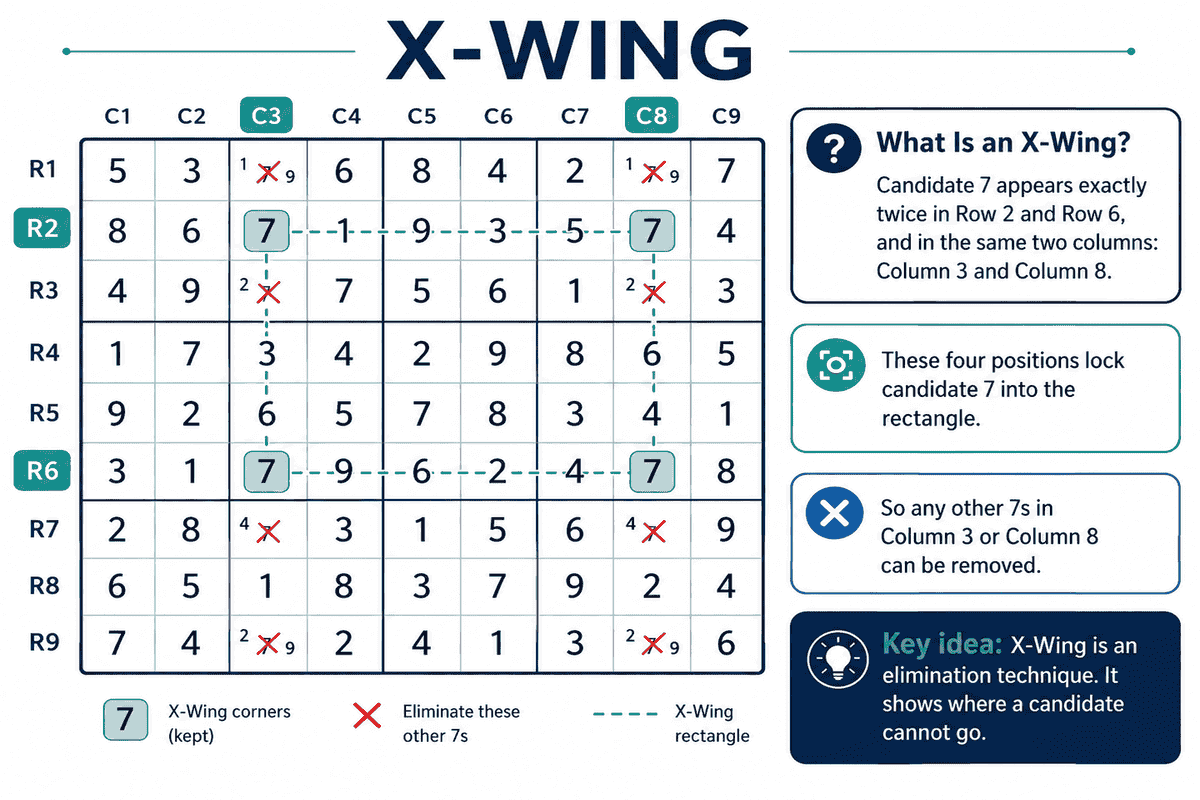
What Is an X-Wing?
An X-Wing occurs when the same candidate appears in exactly two possible positions in each of two different rows, and those positions line up in the same two columns.
The four candidate positions form the corners of a rectangle.
For example:
| Row | Candidate 7 can appear in |
|---|---|
| Row 2 | Column 3, Column 8 |
| Row 6 | Column 3, Column 8 |
In this case, candidate 7 forms an X-Wing using:
- Row 2
- Row 6
- Column 3
- Column 8
Because each of those two rows must contain a 7, and the only possible columns are the same two columns, the 7s are locked into that rectangle.
That means any other candidate 7s in Column 3 or Column 8 can be removed.
Why X-Wing Works
The logic is based on a simple either-or relationship.
Using the example above:
- If Row 2 places 7 in Column 3, then Row 6 must place 7 in Column 8.
- If Row 2 places 7 in Column 8, then Row 6 must place 7 in Column 3.
There are only two possible arrangements.
In both arrangements, Column 3 and Column 8 will already contain their 7s inside those two rows.
So any other 7s in those columns are impossible.
This is the key point:
X-Wing does not tell you exactly where the 7 goes.
It tells you where the 7 cannot go.
A Practical Example
Suppose you are checking candidate 5 and you notice this:
| Row | Possible positions for 5 |
|---|---|
| Row 3 | Column 2, Column 9 |
| Row 7 | Column 2, Column 9 |
No other cells in Row 3 or Row 7 can contain 5.
This creates an X-Wing.
The four corners are:
- r3c2
- r3c9
- r7c2
- r7c9
Now look down Column 2 and Column 9.
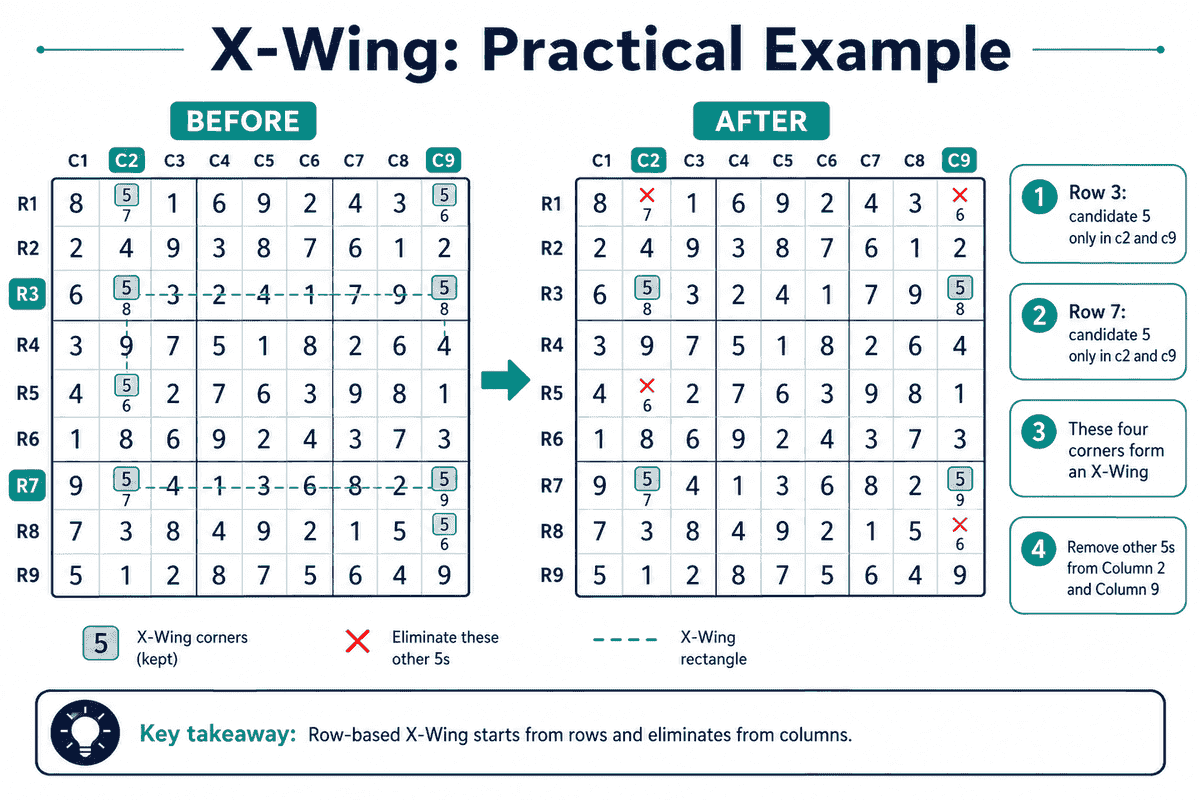
If there are any other candidate 5s in those columns, they can be removed.
For example:
- r1c2 cannot be 5
- r5c2 cannot be 5
- r8c9 cannot be 5
Those eliminations may then create singles, pairs, or other useful patterns.
Row-Based X-Wing
The most common way to learn X-Wing is row-based.
A row-based X-Wing has this structure:
- Choose one candidate.
- Find two rows where that candidate appears exactly twice.
- Check whether the two rows use the same two columns.
- If they do, remove that candidate from the rest of those columns.
The elimination happens vertically.
That last detail is important.
When the pattern starts from rows, the candidates are removed from columns.
Column-Based X-Wing
X-Wing also works in the opposite direction.
A column-based X-Wing happens when a candidate appears exactly twice in each of two columns, and those positions line up in the same two rows.
For example:
| Column | Candidate 4 can appear in |
|---|---|
| Column 1 | Row 2, Row 8 |
| Column 6 | Row 2, Row 8 |
This forms an X-Wing on candidate 4.
Now the elimination goes across the rows.
Any other candidate 4s in Row 2 or Row 8 can be removed.
So:
- Row-based X-Wing eliminates from columns.
- Column-based X-Wing eliminates from rows.
How to Spot an X-Wing
The best way to find X-Wings is to scan one candidate at a time.
Do not look for rectangles randomly. That usually becomes confusing.
A better method is:
- Pick a number, such as 6.
- Check each row and mark rows where 6 appears exactly twice.
- Compare those rows.
- Look for two rows with matching column positions.
- If you find a match, check for eliminations.
Then repeat the same process with columns.
This sounds slow at first, but it becomes much faster with practice. Strong solvers are not calculating every possibility from scratch. They are recognizing repeated structures.
What Makes a Valid X-Wing?
A valid X-Wing needs three things:
1. Same candidate
All four corners must involve the same number.
You cannot combine different candidates into one X-Wing.
2. Exact alignment
The two rows must share the same two columns, or the two columns must share the same two rows.
A rectangle by itself is not enough.
3. Restricted positions
In a classic X-Wing, the candidate should appear exactly twice in each of the two base rows or columns.
If one of the rows has an extra possible position for that candidate, the pattern is not a clean X-Wing.
Common Mistakes
Mistake 1: Treating Any Rectangle as an X-Wing
Four matching candidates in a rectangle may look convincing, but that is not enough.
The candidate must be restricted in the correct rows or columns.
If the number can still appear elsewhere in one of the base units, the logic breaks.
Mistake 2: Eliminating from the Wrong Direction
This is probably the most common error.
If the X-Wing is built from rows, eliminate from the columns.
If the X-Wing is built from columns, eliminate from the rows.
The direction matters.
Mistake 3: Expecting an Immediate Placement
X-Wing is an elimination technique.
Sometimes it removes several candidates and immediately creates a single.
Other times it only makes the grid slightly cleaner.
That does not mean the technique failed. Many advanced Sudoku strategies work by gradually reducing possibilities.
X-Wing vs Naked Pair
X-Wing can feel similar to Naked Pair because both involve two options.
But they operate at different levels.
A Naked Pair is local. It usually happens inside one row, column, or box.
An X-Wing is structural. It connects two rows and two columns across the grid.
| Technique | Main Focus | Typical Result |
|---|---|---|
| Naked Pair | Two cells in one unit | Remove candidates from that unit |
| X-Wing | Two rows and two columns | Remove candidates across aligned rows or columns |
This is why X-Wing often appears in harder puzzles. It requires you to see relationships beyond a single region.
When Should You Look for X-Wing?
X-Wing is worth checking when easier techniques stop working.
Before searching for X-Wing, you should usually try:
- Naked Singles
- Hidden Singles
- Naked Pairs
- Hidden Pairs
- Locked Candidates
If those techniques no longer create progress, X-Wing becomes a natural next step.
It is especially useful in puzzles where a candidate appears in repeated pairs across several rows or columns.
A Good Practice Habit
When learning X-Wing, do not try to find every advanced pattern at once.
Pick one candidate and scan the whole grid.
For example, check all possible positions for 1.
Then check 2.
Then 3.
This builds discipline and prevents random scanning.
Over time, you will start noticing that certain candidates form clean two-position patterns. Those are often where X-Wings begin.
Final Thoughts
X-Wing is a turning point technique for many Sudoku players.
It teaches you to stop looking only at individual cells and start reading the grid as a system of relationships.
The logic is not guesswork. It is precise, limited, and reliable.
Once you understand how X-Wing controls rows and columns, more advanced techniques such as Swordfish and Jellyfish become much easier to understand.
The important thing is patience.
At first, X-Wing may feel hard to see. But after enough practice, the rectangle structure becomes familiar, and candidate eliminations that once seemed hidden begin to stand out naturally.