Sudoku Tips: Naked Single Explained Clearly
By OnlineSudoku 4 months ago 221 views
Learn what a Naked Single is in Sudoku, why it is the most fundamental solving technique, and how to use it correctly when working with candidates.
Naked Single is the most basic Sudoku technique, but it is also one of the most important.
Many players think of it as a beginner move because it looks simple: a cell has only one possible number left, so that number must go there.
That is true, but the real value of Naked Single is not just filling an obvious cell. It is learning how Sudoku logic works at the candidate level.
Every advanced technique eventually comes back to the same principle: remove impossible candidates until only one valid option remains.
Naked Single is the cleanest version of that idea.
What Is a Naked Single?
A Naked Single occurs when an empty cell has only one possible candidate left.
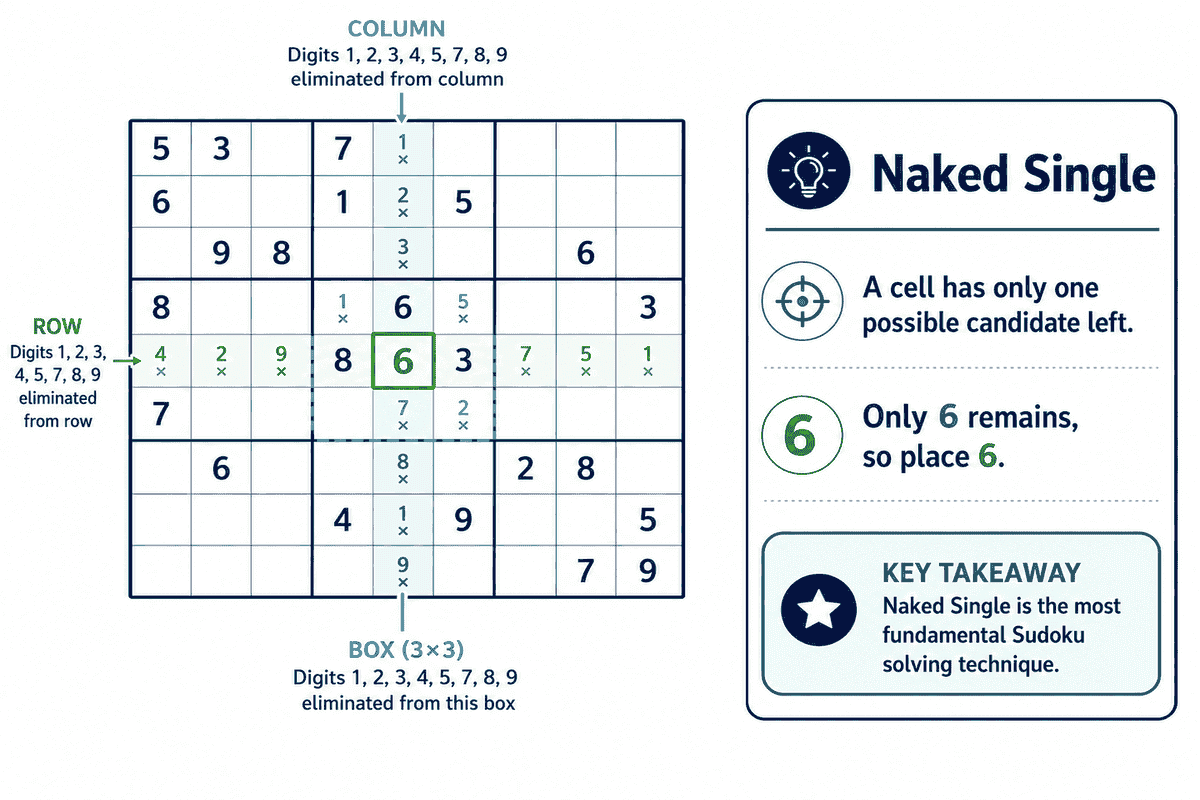
For example, if a cell can no longer contain any number except 6, then 6 must be placed in that cell.
The number is called “naked” because the answer is visible directly from the cell’s own candidates.
There is no need to compare hidden positions across a row, column, or 3×3 box. You simply look at the cell and see that only one option remains.
A Simple Example
Imagine an empty cell in a Sudoku grid.
Because of the numbers already placed in the same row, column, and 3×3 box, this cell cannot be:
- 1
- 2
- 3
- 4
- 5
- 7
- 8
- 9
The only number left is:
- 6
So the cell must be 6.
That is a Naked Single.
The logic is direct: if every other number is impossible, the remaining number is forced.
Why Naked Singles Matter
Naked Singles are important because they often create momentum.
Placing one number changes the puzzle immediately. It affects:
- the row
- the column
- the 3×3 box
Once the number is placed, it removes that same candidate from nearby cells.
That can create more Naked Singles, Hidden Singles, or other candidate eliminations.
This is why many Sudoku puzzles begin to solve in chains. One correct placement leads to another.
A single Naked Single may look small, but it can unlock an entire section of the grid.
Naked Single vs Hidden Single
Naked Single and Hidden Single are often confused, but they are not the same technique.
| Technique | What You Look At | Logic |
|---|---|---|
| Naked Single | One cell | The cell has only one candidate left |
| Hidden Single | One row, column, or box | A number has only one possible position |
A Naked Single is about a cell.
A Hidden Single is about a number’s position within a unit.
For example:
- If a cell contains only candidate 4, that is a Naked Single.
- If candidate 4 appears in only one cell within a row, that is a Hidden Single.
Both techniques are fundamental, but they require different scanning habits.
How to Find Naked Singles
There are two common ways to find Naked Singles.
Direct Visual Scanning
This works best in easier puzzles.
Look for empty cells surrounded by many placed numbers. If the row, column, and box already contain most digits, the remaining option may be obvious.
This method is fast, but it becomes less reliable in harder puzzles.
Candidate-Based Scanning
This is the better method for serious solving.
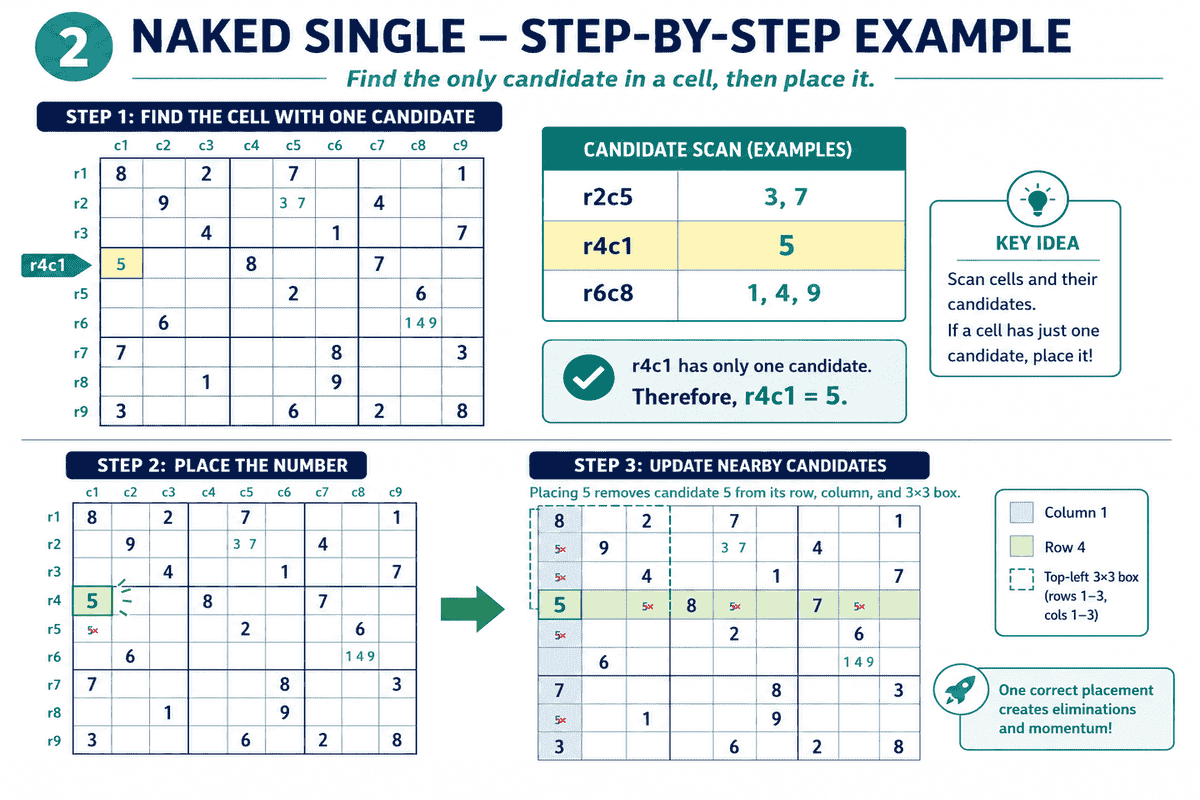
Write or display candidates for each empty cell, then look for cells with only one candidate remaining.
For example:
| Cell | Candidates |
|---|---|
| r2c5 | 3, 7 |
| r4c1 | 5 |
| r6c8 | 1, 4, 9 |
The cell r4c1 has only one candidate.
So r4c1 = 5.
This is a Naked Single.
Why Candidates Must Be Accurate
Naked Singles are only as reliable as the candidates behind them.
If your pencil marks are incomplete or wrong, a false Naked Single can appear.
This is one of the most common mistakes among newer players.
Before placing a Naked Single, make sure the candidate list has been updated correctly after recent placements.
A good habit is to check the cell against its:
- row
- column
- box
If the candidate is still the only legal option after that check, the placement is safe.
Common Mistakes
Mistake 1: Confusing a Guess with a Naked Single
A Naked Single is not a number that “seems likely.”
It is a number that is forced because all other candidates are impossible.
If there are two possible candidates left, it is not a Naked Single.
Even if one option feels more promising, the logic is not complete yet.
Mistake 2: Forgetting to Update Nearby Candidates
After placing a Naked Single, the same number must be removed from related cells in the same row, column, and box.
For example, if you place 8 in a cell, then no other cell in that row, column, or box can contain 8.
Failing to update candidates can cause the puzzle to stall later.
Many “hard” positions are actually caused by missed clean-up after simple placements.
Mistake 3: Looking Only for Nearly Finished Rows
Some players search for Naked Singles only in rows or boxes that are almost complete.
That works in easy puzzles, but it misses many opportunities.
A Naked Single can appear anywhere, especially after candidate eliminations from pairs, locked candidates, or X-Wing patterns.
The cell does not need to be visually surrounded by numbers. It only needs one legal candidate left.
When Should You Use Naked Singles?
You should look for Naked Singles throughout the entire puzzle.
They are especially useful:
- at the beginning of easy puzzles
- after placing any number
- after applying candidate elimination techniques
- when the puzzle starts moving again after a difficult step
In harder puzzles, Naked Singles often appear as the result of another technique.
For example, an X-Wing might remove a candidate from a cell, leaving only one option behind.
At that moment, the advanced technique has done its job, but the actual placement is still a Naked Single.
A Practical Solving Habit
After every placement, pause briefly and check what changed.
Ask:
- Did this create a cell with only one candidate?
- Did it remove a candidate from nearby cells?
- Did it make a row, column, or box easier to scan?
This habit prevents missed opportunities.
Strong Sudoku players are not just finding difficult techniques. They are also very good at catching simple consequences immediately.
That is why they solve faster and make fewer mistakes.
Why Naked Single Is Still Useful in Hard Puzzles
In advanced Sudoku, Naked Singles may not appear at the start.
But they still matter.
Many difficult puzzles are solved by alternating between elimination and placement:
- Use a technique to remove candidates.
- Find a resulting Naked Single.
- Place the number.
- Update the grid.
- Repeat.
This cycle is at the heart of logical Sudoku solving.
Even techniques such as Locked Candidates, X-Wing, Swordfish, and XY-Wing often matter because they eventually produce simple forced moves.
Naked Single is where those eliminations become actual progress.
Final Thoughts
Naked Single is simple, but it should not be dismissed.
It is the foundation of candidate-based Sudoku solving.
The technique teaches an essential habit: do not place a number because it looks good; place it because every alternative has been eliminated.
Once that habit becomes natural, harder techniques become much easier to understand.
Good Sudoku solving is not about guessing the right answer.
It is about narrowing the puzzle until the right answer is the only answer left.